Cybersecurity training videos for business
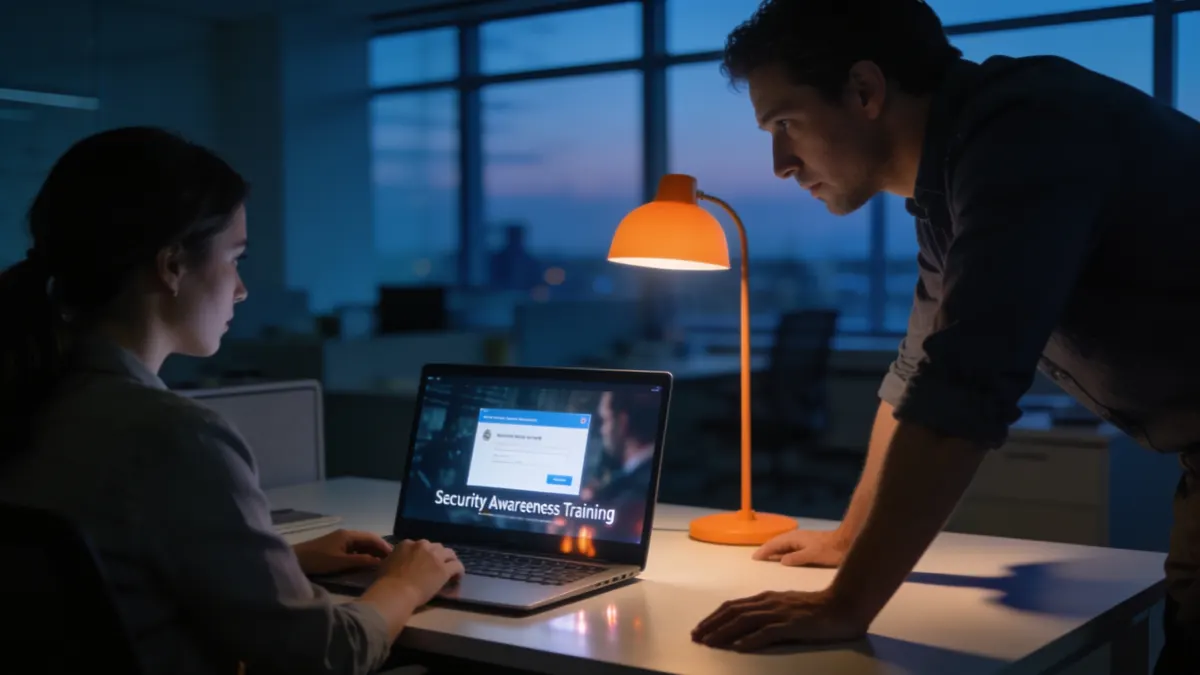
An awareness campaign rarely fails because an employee has never heard the word phishing. It fails when they do not recognise the urgent message, false invoice or call that appears to come from management at the moment a decision is required. Video lets people rehearse those situations before they happen. At scale, one film is not enough: you need a modular library that can change without producing everything again.
This is not a tutorial for making videos with a tool, nor a course catalogue. It is for cybersecurity companies, consultancies, L&D departments and security teams commissioning a finished audiovisual programme, with their specialist validating the subject matter and a production team taking responsibility for script, visuals, versions and delivery.
First: who owns cybersecurity expertise and who produces the learning
Expert responsibility must stay clear. The CISO, consultancy or training provider defines the correct behaviour, internal policy and concepts that cannot be oversimplified. The production company turns that knowledge into situations people recognise, understand and remember.
- The client specialist validates concepts, procedures, internal rules and the correct response.
- The production team designs learning structure, script, visual direction, edit, sound, accessibility and versions.
- The L&D owner approves delivery format, LMS integration and the data the programme needs to measure.
We produce the audiovisual content; we do not replace the cybersecurity specialist or independently certify the training.
What an awareness library should contain
Do not begin with “we need thirty videos”. Begin with the decisions each audience must practise:
- Email and messaging: phishing, shortened links, attachments, malicious QR codes and urgent requests.
- Social engineering: CEO fraud, fake technical support, pretexting and supplier impersonation.
- Access and devices: passwords, MFA, USB media, personal devices and remote work.
- Data: wrong recipients, classification, storage, printing and conversations in public spaces.
- Response: stop, verify through another channel, report and preserve evidence without hiding the mistake.
The production job is to turn this map into short modules, each tied to an observable behaviour, rather than one long film that tries to explain everything.
The most useful format: situation, decision and consequence
An effective micro-video starts with a scene, not a definition: an apparently normal invoice, a call asking someone to bypass procedure or a QR code beside the printer. The viewer identifies the signal, makes a decision and sees the consequence.
- Recognisable context. A realistic role, channel and pressure.
- Decision point. A pause or question that requires a choice.
- Correct response. The exact action and the organisation's reporting route.
- Reinforcement. One concise rule that can be recalled outside the course.
A phishing simulation measures behaviour; video explains and rehearses why it should change. They complement rather than replace one another.
How to produce volume without losing control
For ten, thirty or one hundred pieces, the saving does not come from randomly generating every shot. It comes from designing a system first:
- an approved library of characters, locations, interfaces and graphics;
- a script template covering objective, risk, decision and close;
- brand, tone, terminology and realism rules;
- a matrix of modules, audiences, languages, formats and approval status;
- continuity control and human review of every export.
AI can recreate fraud scenarios and character or context variants that would be expensive or sensitive to shoot. Real footage remains better for an exact physical procedure, a specific facility or a real spokesperson. The right workflow can be generated, filmed or hybrid; the learning objective decides.
Design the update before the threat changes
A useful library is delivered ready to change. Voice, captions, on-screen text, variable scenes and brand elements remain separate so that a new policy, reporting channel or fraud pattern does not force a complete remake.
The version register should state what changed, who validated it, which languages are affected and which module it replaces. Updating then becomes controlled editorial maintenance rather than a new production.
Languages, accessibility and LMS are not last-minute extras
For a multilingual workforce, the design must allow for narration length, on-screen copy and human review in each language. Accessibility is more than automatic subtitles: WCAG 2.2 calls for synchronised captions for prerecorded audio, including the sound information needed to understand the media.
Decide before production whether you need:
- video masters and caption files;
- transcripts and, where appropriate, descriptions of visual information;
- a SCORM/xAPI package for Moodle or another LMS;
- questions, decision points and tracking;
- deliveries by language, country, role or business unit.
The technical format should be validated with the team that operates the LMS, not imposed after picture lock.
The brief that makes a real quote possible
- Who validates the subject matter?
- Which audiences must change which behaviour?
- How many modules and what approximate duration?
- Which languages and accessibility requirements?
- Where will it live: LMS, intranet, email, live sessions or an ongoing campaign?
- What already exists: curriculum, policies, simulations and brand assets?
- What must remain updateable, and how often?
Those answers support a representative pilot, acceptance criteria and a reliable scope for the full system, without mistaking an attractive demo for an operational library.
What we deliver—and what we do not promise
We can take on learning script, visual production, voice, sound, captions, versions, LMS packaging and a record of sources, rights, decisions and versions. The expert organisation retains subject-matter validation and any required certification. We also do not pretend a video alone eliminates risk: it belongs alongside policy, controls, simulations and a reporting route that works.
Need a finished and updateable library rather than instructions for making it yourself? Tell us about the modules, languages and LMS; we will scope the pilot and production system with you.