AI renovation design: in-house 3D-based demonstration
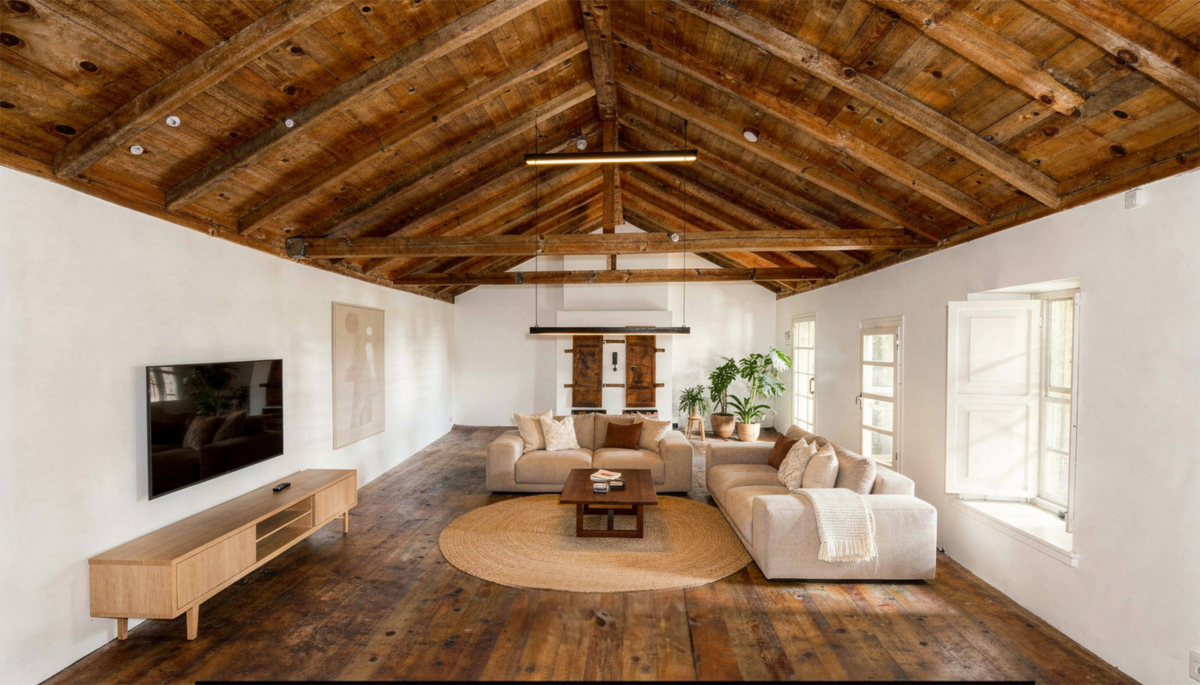
In-house demonstration, not a client commission: a 6-room, 72 m² exercise built on a 3D LiDAR base to show how renders and layout decisions are directed.
Renovating blind is expensive. Designing a renovation with imprecise plans, renders of fictional furniture and measurements that don't match the real space generates unexpected costs, rework and friction with contractors. The result: projects that overrun budget, calendars that stretch and a client who ends up installing furniture that doesn't fit.
Where generic tools fall short
- Standard design tools work with approximate dimensions: a 5 cm error in a corridor can invalidate the selected furniture and force redoing the entire layout phase
- Generic renders ignore the real structures of the space: columns, drains, beams and irregularities that condition every design decision are left out of the model
- The furniture shown in typical renders doesn't exist in any catalog: the client approves a visual proposal that can never be executed as such, generating frustration at purchase time
- Without precise technical documentation, contractors work with their own interpretations that multiply misunderstandings, queries and on-the-fly modifications
3D scan + generative AI: a measurable base
A LiDAR scan provides a measured base of the space and records corners, level changes and irregularities within the accuracy of the device and capture. Critical dimensions are checked on site before a visualisation becomes a technical decision.
From that measured base, generative AI proposes within documented constraints. This reduces uncertainty compared with estimates, but it does not remove measurement tolerances or replace technical verification.
The result is a set of directed renders built on a measurable base. Catalogue references, dimensions, finishes and availability are checked when they form part of the agreed scope; the visualisation is not, by itself, construction documentation.
From real space to complete project
LiDAR scan of the real space
Capture of the visible property geometry within the documented tolerances of the equipment and survey. The model is a working base, and critical dimensions are verified before construction.
Design with generative AI
Using the measured base as a reference, generative AI helps explore layouts, palettes, finishes and furniture. The number of alternatives per room and their validation level are defined in the proposal.
Room-by-room validation
When catalogue checking is in scope, the selected items’ reference, dimensions, finish and availability are documented. Final purchasing and installation compatibility remains subject to on-site measurement, current product data and professional validation.
Delivery to the agreed scope
The proposal defines which rooms, plans, references, variants and files are delivered. Renders support visual decisions but do not replace technical design, permits, calculations or review by the relevant professional and contractor.
72 m² and 6 rooms in an in-house demonstration
The exercise models a 72 m² home distributed over 6 rooms: living-dining room, kitchen, two bedrooms, main bathroom and toilet. The base includes three structural irregularities as design constraints to show how decisions are documented and compared.
In the demonstration, joinery, proportions and natural-light orientation are preserved as visual constraints. Any solution intended for construction must then be checked against measurements, regulations and professional technical judgement.
AI Renovation Design
Renovation visualisation with a 3D LiDAR base, generative AI and directed renders. Scope, catalogue references, tolerances, variants and deliverables are documented in the proposal. See other AI design projects.