A client asks about a shot from eight months ago: what if you never recorded it
On 7 October Google opened its watermark detector to anyone. Phil Tippett is finishing the sequel to Mad God with software whose only job is knowing where each shot came from. And a new question is starting to appear in the paperwork from large clients: how much of this piece is filmed material. Documenting where an image came from has stopped being an afterthought.
The awkward question always arrives late, and it arrives like this: a client asks to change one detail in a shot approved eight months ago. Which model, which version and which references produced it? With no record, the answer is that nobody knows, and redoing it costs more than writing it down would have.
The short version
- Traceability is becoming production infrastructure, not legal paperwork for afterwards.
- SynthID confirms a Google watermark or a partner's. A negative result does not prove the material is real, and the mark does not survive an aggressive transcode.
- Licence thresholds vary tenfold between models, and they are measured against your revenue, not the budget of the piece.
- Recording is not guaranteeing: what you sign for the client is a different document, and the two are worth keeping apart.
LOFT does not generate images: it records who approved which
Phil Tippett, who spent thirty years finishing Mad God frame by frame, is producing the sequel with LOFT, software from LOFTAPPS that made its European debut at the VIEW Conference in Turin, 12 to 16 October.
What matters is what it does not do. It generates nothing.
It connects the models to the people, the assets and the approvals of a production. It manages assets, prompts, versions and provenance, and keeps every generation tied to the context that produced it: which references were used, which model, who reviewed it and what approval state it is in. The company insists on separating the production layer from the generation layer, with an argument anyone who has changed tools mid-project recognises: the models will change, and the production system should not have to be rebuilt with them.
That said, LOFT is for productions with hundreds of generated shots and a team coordinating them. For a mid-sized studio it is not a purchase, it is a signal of where the problem has moved.
What is happening with voices, and the only part that affects you
SAG-AFTRA is putting the 2026 Television Animation Agreement to a vote until 29 October, extending to animation the AI protections won in June for live action. It applies in the United States and to productions under the agreement, so most of its content (wage increases, streaming residuals) does not reach you.
One idea does travel, and it comes from the previous contract, from 2024. Protection of a digital replica does not depend on it sounding like the performer's natural voice. It is enough that contracts or records show it was created from their work. It solved a problem specific to the craft: a voice actor brings to life characters who sound nothing like them.
That translates into a clause, not a headline. If you work with generative voice in corporate or advertising, what matters is the document behind each voice: explicit authorisation, defined use, a term, and payment if it gets reused. What is negotiated in Los Angeles today shows up later in the assignment clauses of any voice-over contract.
SynthID confirms; it does not absolve
On 7 October Google opened SynthID Detector to the public at synthid.com. You upload an image, a video or an audio file and it checks for SynthID, the invisible mark the company has embedded since 2023 in content made with its models. It also recognises material from partners who adopted the same technology, among them OpenAI, NVIDIA and Kakao.
The limitation is on the page itself: it is not a general AI detector. It only recognises marks from participating systems. Content from open models without that mark, from tools outside the agreement, or predating its adoption, passes without warning. A negative result does not prove a video is authentic, only that it does not carry that particular mark.
checks per user per day. Enough to review one piece that arrives with doubts; not enough to audit a library. Google rations access to stop the detector being used to develop ways of stripping the mark. Ars Technica, October 2026
Two more things worth knowing before you lean on it. The mark does not survive an aggressive transcode, a re-capture or a heavy regrade, so a negative on material that has been through a delivery chain is doubly meaningless. And its real use is not on what you produce (you already know how you made that) but on what comes in: archive, stock, user material and plates sent by the client.
C2PA: the standard clients will eventually ask for
SynthID is one vendor's mark. The industry's open standard is another: C2PA, known in products as Content Credentials. Instead of an invisible mark, it attaches a signed history to the file: who made it, with what, and what edits it has been through.
Nobody is putting it in a brief yet, but that is the direction, and it has the advantage of not depending on which model you used. If you are building a provenance workflow this year, check whether your tools already write it before inventing a system of your own.
Two licence thresholds and the case nobody raises
October's open-weight models come with free commercial licences whose revenue ceilings look nothing alike. FLUX 3 Image Klein, from Black Forest Labs, is free below five million dollars in annual revenue. Fish Audio Drama 3, below 500,000. Ten times lower, and a figure a twenty-person studio can brush against.
The threshold is measured against your company's revenue, not the budget of the piece. But in advertising the normal situation is different: you produce for a brand that bills hundreds of times what you do. There, who is bound depends on who exploits the work and under what assignment, and it is not settled by skimming the licence. If the job is a large one, have somebody look at it before you start, not on delivery.
What we record on every delivery
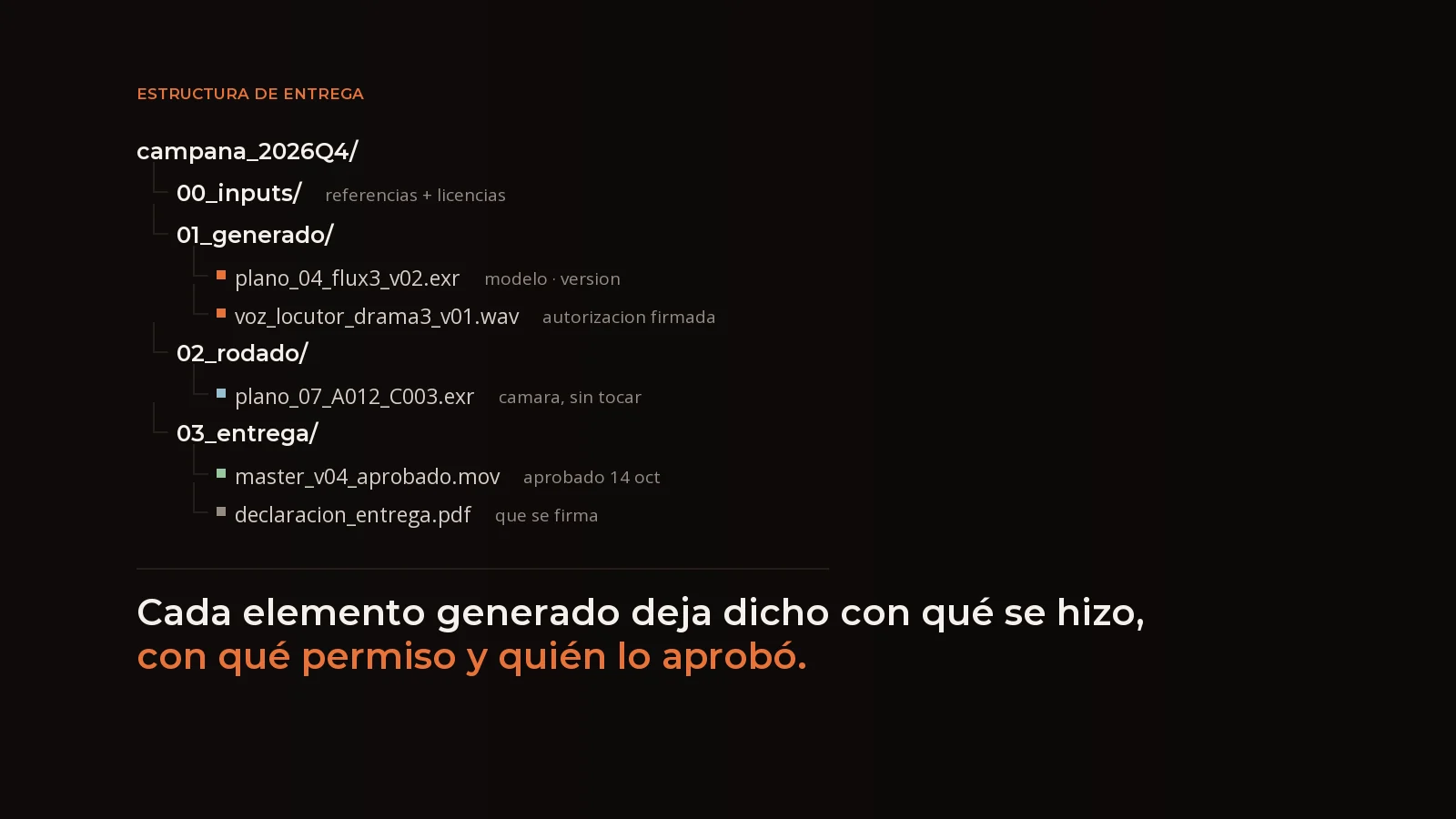
We do not use LOFT. At our volume the record lives inside the delivery structure itself, the one we show in our service for agencies: folders by phase, naming with version and state. The model and its version go in the filename, not in a separate sheet, and the After Effects or Nuke project is archived with the delivery, because the node graph is the most faithful record there is.
What gets asked of us most these days comes from legal departments before it comes from creative teams: telling apart which material was filmed, which was retouched and which was generated. On archive projects like Teneguía 1971 it stops being a preference, because when you recover historical material, separating what was on the negative from what has been reconstructed is part of the job.
And what we sign, which is something else
Two documents that look alike are worth keeping apart. The record says how each shot was made and lets you reproduce, correct or defend it. The delivery declaration is what you sign for the client, stating which licences the work was produced under, which image and voice authorisations exist, and what generated material the piece contains.
Having the first does not oblige you to sign the second in unlimited terms, and not having it makes signing anything with any grounding impossible. If a client asks for an unlimited non-infringement warranty, that is not a traceability question, it is an insurance and legal counsel question.
Seven columns, and where they live
The unit is the generated element, not the piece: a thirty-second spot can carry forty. And it does not live in a separate sheet, which gets abandoned in week two, but as fields in the project tracker you already use, or in a file next to the render.
- Model and version, with the date. Models change and results do not reproduce themselves.
- Input references: which images, voices or footage fed the generation, and where they came from.
- Where those inputs are kept, and until when. The evidence is the inputs, not the box saying they existed.
- Licence and threshold, and whether your revenue is still under the ceiling.
- Authorisations for voice and likeness: written permission, defined use, term and reuse conditions.
- Approval, keeping internal sign-off separate from the client's, with date and version.
- What gets declared on delivery, which is what the client takes away in writing.
Production fills it in at every delivery, never at project close. Done as you go it is ten or fifteen minutes; done afterwards it is two days and it comes out wrong. The model and reference columns are completed by whoever made the shot, because they are the only one who knows.
Sources
Checked as of 17 October 2026:
- Animation World Network, «LOFTAPPS to Debut LOFT Software and Peek at Phil Tippett's Mad God Sequel at VIEW 2026» (6 October 2026).
- Animation World Network and Cartoon Brew on SAG-AFTRA's 2026 Television Animation Agreement, and the union's own 2024 animation agreements.
- Google, SynthID Detector public release announcement (7 October 2026), and Ars Technica on the check limit.
- Black Forest Labs, FLUX Kommunity licence for FLUX 3 Image Klein. Fish Audio, Drama 3 Community License.
If you are building the delivery workflow for a campaign with generated material and you want traceability built in, this is how we work with agencies.