AI in video: the 4 fears that actually stall a call
The fear that AI will replace production companies is the comfortable headline, but it is not the one that will cost you money. The risks that actually stall a decision are four others, and above them all looms a reputational one: «AI slop».
A global brand launches its AI-generated Christmas ad. Within hours, the comments aren't about the product: they're about how fake it looks. McDonald's Netherlands ended up pulling one after complaints. Coca-Cola weathered the storm and did it again. Meanwhile, in the meeting rooms of production companies and agencies, a different conversation keeps coming up, and it almost always starts with the wrong fear.
If you run a production company, an agency or a marketing department, you've probably heard, or thought, that AI is going to replace you. It's the comfortable headline. But it isn't the problem that will really cost you money. The fears that paralyse a firm are four others, more specific and less cinematic. Those are what we'll talk about plainly: what's mature, what's still hype, and which risk the audience really punishes.
The wrong fear: «AI is going to replace me»
Why 2026 is no longer about replacement, but about infrastructure
The industry conversation has shifted. Heading into Cannes Lions 2026 (the biggest gathering of the creative industry, held in late June), the mood is no longer fascination but demand: showing off that you used AI is over; now you have to prove it worked. The interesting question stopped being «does it replace me?» and became «how do I use it with judgement?».
Why? Because AI is becoming infrastructure, not a substitute. Just as Photoshop or a video editor didn't fire photographers or editors but became baseline tools, generative AI is settling into that invisible background. OpenAI's official timetable offers another reason to avoid rigid dependencies: Sora's web and app experiences were discontinued on 26 April 2026, and the API will be discontinued on 24 September 2026. The notice confirms those dates but does not attribute the decision to an economic cause.
Human creativity isn't diluted, it becomes more profitable
Here it pays to look at data, not intuition. A study by Luchini and colleagues (Penn State, 2025) had 442 people solve creative tasks with the same AI model available to them. The result: those who started with greater creative skill and better cognitive abilities kept producing more original ideas. AI didn't erase the differences between professionals; judgement still made the difference.
There's a second finding that complements it and that you should keep firmly in mind. Research published in Science Advances (Doshi and Hauser, 2024) found that generative AI improves each individual author's creativity, especially the least experienced, but makes the results more alike. In other words: it raises the floor, but it homogenises. And what happens when everyone uses the same tools and everything starts to look the same? Having a voice of your own becomes scarce. And what's scarce is what commands a premium. That's why judgement isn't devalued by AI: it appreciates.
The four real fears that do stall a firm
These are the ones that genuinely stop a decision. We unpack each one in the next articles of the series.
«Will this pay off?»: ROI with no return
The first is money. They sell you efficiency, but where is the measurable return? AI delivers real savings in some parts of the pipeline and not in others, and confusing the two is costly. The right question isn't which technology is flashier, but which task it actually speeds up. (We break it down with numbers in the second article of the series.)
«Which tool do I choose without getting trapped?»: the stack decision
The second is technical and commercial at once: choosing badly. The model market reshuffles every few weeks (Sora's web and app experiences were discontinued, while Chinese models like Kling or Seedance climbed the rankings) and nobody wants to be locked into a vendor or, worse, leak a client's sensitive material. The mistake is to start from the trendy model instead of from your own criteria. (How to choose without getting it wrong, in the third article.)
«Will I lose my creative signature?»: homogenisation
The third is identity. If AI homogenises, and the data says it does, won't your work end up indistinguishable from the competition's? It's a legitimate fear, and it has an answer: differentiation doesn't come from a tool, but from a point of view. (Your competitive moat, in the fourth article.)
«Can I scale without diluting my brand?»: volume
The fourth is scale. Producing more variants and more languages sounds great until volume starts cheapening the brand. You can scale with judgement, but not on autopilot. (Volume with brand control, in the fifth article.)
The risk people actually talk about on the street: «AI slop»
Why audiences punish AI used badly
Beyond those four internal fears, there's one that settles the conversation outside: the audience. And the numbers are not small. According to a CivicScience survey (2025), only 18% of US adults have a positive view of brands that use AI in advertising, versus nearly two in five with a negative view; 36% say they'll buy less from a brand if they know its ad was made with AI. The IAB (2026) adds an uncomfortable nuance: rejection is higher among Gen Z (39% negative, almost double that of millennials), precisely the most digitally native audience. And a NIQ study (2024) found that AI ads, even those perceived as «high quality», activate memory less and carry a negative halo effect: they're seen as flatter and more annoying.
Translated: it's not that AI doesn't work technically. It's that, used badly, the audience spots it and penalises the brand. Coca-Cola was mocked for Christmas trucks with impossible physics; McDonald's Netherlands pulled an ad after complaints. That's «AI slop»: content that looks generated and cheap.
The brands' pivot: now they boast about being «anti-AI»
The market's response is telling. Some brands have turned «we don't use AI» into a selling point. Aerie (American Eagle) pledged in October 2025 not to use AI-generated bodies or people; the ad became its most-viewed post of the year and the brand launched a campaign with Pamela Anderson contrasting the coldness of AI models with real people. The figure that matters? Its comparable sales grew 23% year over year in the last quarter of 2025. Its CMO put it well: when everything is generated, the real becomes unique. Dove had already paved the way in 2024 with its pledge not to use AI to portray women, and brands like Equinox, Le Creuset or Almond Breeze have joined in presenting themselves as the honest alternative to «slop». The «no AI» label is starting to work the way «handmade» once did.
What this means for whoever hires production
And what does this have to do with you, the one who hires or produces? That the underlying fear isn't technical, it's reputational. The question a client asks isn't «is this made with AI?», but «is this going to make my brand look cheap?». Whoever produces has to explain and demonstrate how that risk is controlled, whether or not AI is used under the hood. That's the real brief.
What's mature and what's still hype
Mature today
Let's be specific, no smoke and mirrors. Today AI brings real, consistent value in bounded tasks: previsualisation and storyboards to sell a project better before shooting; editing and post-production tasks (audio cleanup, tagging, assisted colour); localisation, subtitling and dubbing into several languages; and generating variants at scale for advertising. In all of this, AI genuinely speeds things up.
Not yet
And where is it still a promise? In premium content generated 100% autonomously. A McKinsey report (2025) on film and TV is blunt: as of today, AI output still doesn't reach, in many cases, the premium production standard. Generating a high-end spot or an entire cinematic piece without strong human direction still yields unstable results that have to be reworked. The practical conclusion is simple: AI is excellent as a tool within a directed process, and still weak as a substitute for the whole process.
Our position: AI with judgement, not AI as a fad
What we do differently: human direction + fusion of real footage, drone and AI
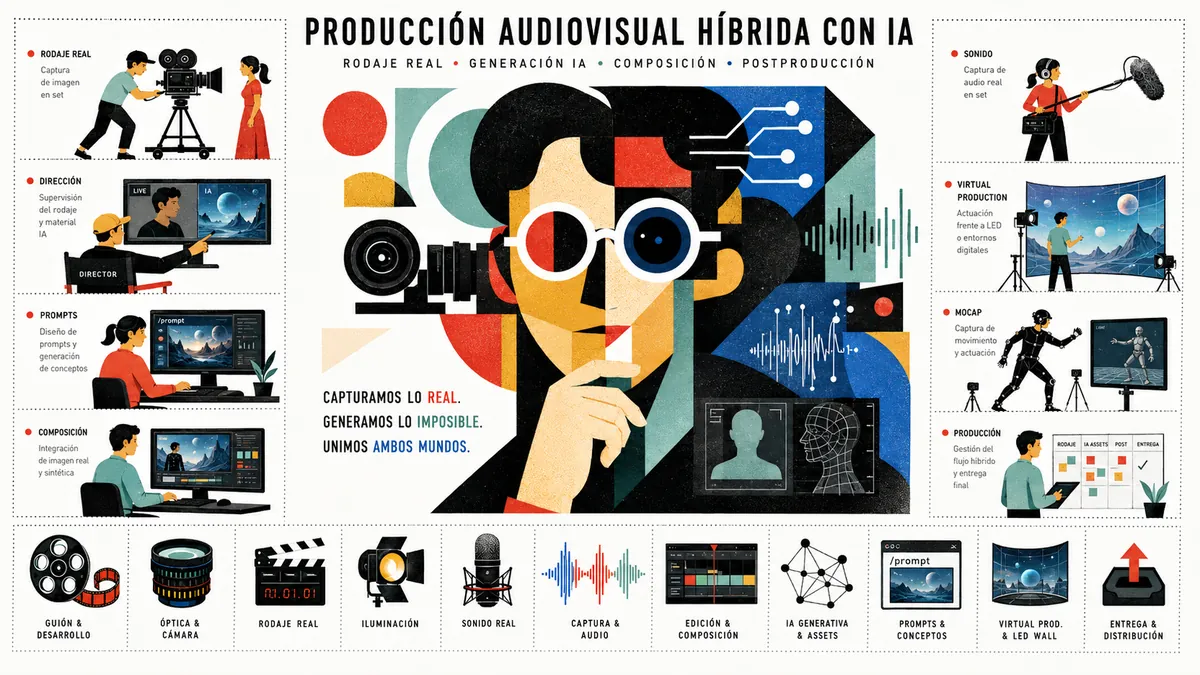
At EficiencIAl Studio we start from a simple idea: AI is not the author, it's a tool under human direction. What can't be copied isn't the model (everyone has it) but the judgement of whoever decides what gets generated and what gets discarded. To that we add something pure AI can't provide: the fusion of real and drone footage with AI generation. The real anchors (authenticity, physical movement, on-location capture); AI extends. It's an especially powerful combination in heritage, industrial and branded content.
How we handle the risk before it blows up on you
And since the real risk is reputational, we tackle it before it reaches the street: human quality control on every delivery to avoid the slop «look», brand coherence above volume, and transparency about which part of the process uses AI when the client needs it. The EU is also starting to require this when it comes to labelling; our AI Act advertising labelling guide covers how to do it, channel by channel.
Conclusion: the right fear is the one you can actually work on
The fear that AI will replace you is the one that should keep you up least at night. The ones that really decide a firm are four (return, tool choice, loss of signature and scale) and above them all looms a reputational one: slop. The good news is that they all have an answer if you work with judgement instead of by fashion.
In the next articles of the series we go into each one in depth: the real ROI of AI in production without the smoke, which tools to choose without getting trapped, how to differentiate yourself with a directed AI workflow, and how to scale variants and languages without breaking your brand.
Are you weighing whether to bring AI into your production and unsure where to start without getting it wrong? Let's talk: an honest diagnosis is worth more than a flashy demo. Request your diagnosis.
Frequently asked questions
Is artificial intelligence going to replace production companies and creatives?
That's not the scenario the data points to. Recent studies (Luchini, 2025) show that, with the same access to AI, the professionals with more judgement keep producing better work. AI is becoming infrastructure, a baseline tool, rather than a substitute. The real risk isn't disappearing, but using it without judgement.
Is it worth using AI in audiovisual production, or is it hype?
It depends on the task. It delivers measurable returns in previsualisation, editing, localisation, dubbing and variants at scale. On the other hand, generating 100% autonomous premium content still gives unstable results (McKinsey, 2025). The key is knowing where it truly speeds things up and where it doesn't.
Why do some AI-made ads trigger rejection?
Because the audience spots them and penalises the brand. Only 18% of consumers have a positive view of brands that use AI in advertising (CivicScience, 2025), and rejection is higher among Gen Z (IAB, 2026). It's called «AI slop»: content that looks generated and cheap. The risk is reputational, not technical.
Is it true that some brands boast about not using AI?
Yes, and it works for them. Aerie turned its «real people only» pledge into its most-viewed post of the year, with sales growth of 23% year over year. Dove, Equinox and Le Creuset have followed similar paths. «No AI» is starting to operate as a quality mark.
Can you use AI without losing your brand's creative signature?
Yes, if AI works under human direction and not the other way round. The judgement of whoever decides what gets generated and what gets discarded is what can't be replicated. Combining real and drone footage with AI is one way to keep authenticity while gaining efficiency.
What should I ask a supplier before hiring AI production?
Less «which model do you use?» and more «what controls keep the result from looking cheap?», «which part is directed by a person?» and «can you show me a case with results, not a demo?». Proof matters more than the promise.
Sources
- CivicScience (2025): consumer sentiment toward AI in advertising (~18% positive, ~40% negative, 36% less likely to buy).
- IAB, «The AI Ad Gap Widens» (2026): higher rejection among Gen Z and an advertiser-consumer perception gap.
- NIQ (2024): AI ads activate memory less and generate a negative halo effect.
- Aerie / American Eagle, Fortune coverage (2025 to 2026): «no AI» pledge and +23% comparable sales in Q4 2025.
- Dove, «Keep Beauty Real» (2024): first beauty brand to pledge not to use AI to portray women.
- Luchini et al., Penn State (2025): with equal access to AI, judgement still drives differences in originality.
- Doshi and Hauser, Science Advances (2024): AI improves individual creativity but homogenises the collective result.
- McKinsey, «What AI could mean for film and TV production» (2025): AI output still doesn't reach the premium production standard.
- Cannes Lions 2026 coverage (Ad Pulse, Fortune): from hype to a demand for proof; human creativity as a differentiator.
- Official Sora / OpenAI discontinuation timetable (2026): web and app experiences discontinued on 26 April; API scheduled for 24 September.