We connect the sources in scope to models validated for the agreed use case: inspection, quality control, counting or document reading. Results that clear configured thresholds may include marked evidence and confidence; low confidence, capture errors and other exceptions go to human review before a report or any action.
Crack · 92%
Damp · 87%
Window · 99%
We first assess representative samples, permissions and source coverage. Only formats and use cases in scope are processed; metrics, thresholds, retention and the review workflow are documented. Not sure where to start? Review our diagnostic tools.
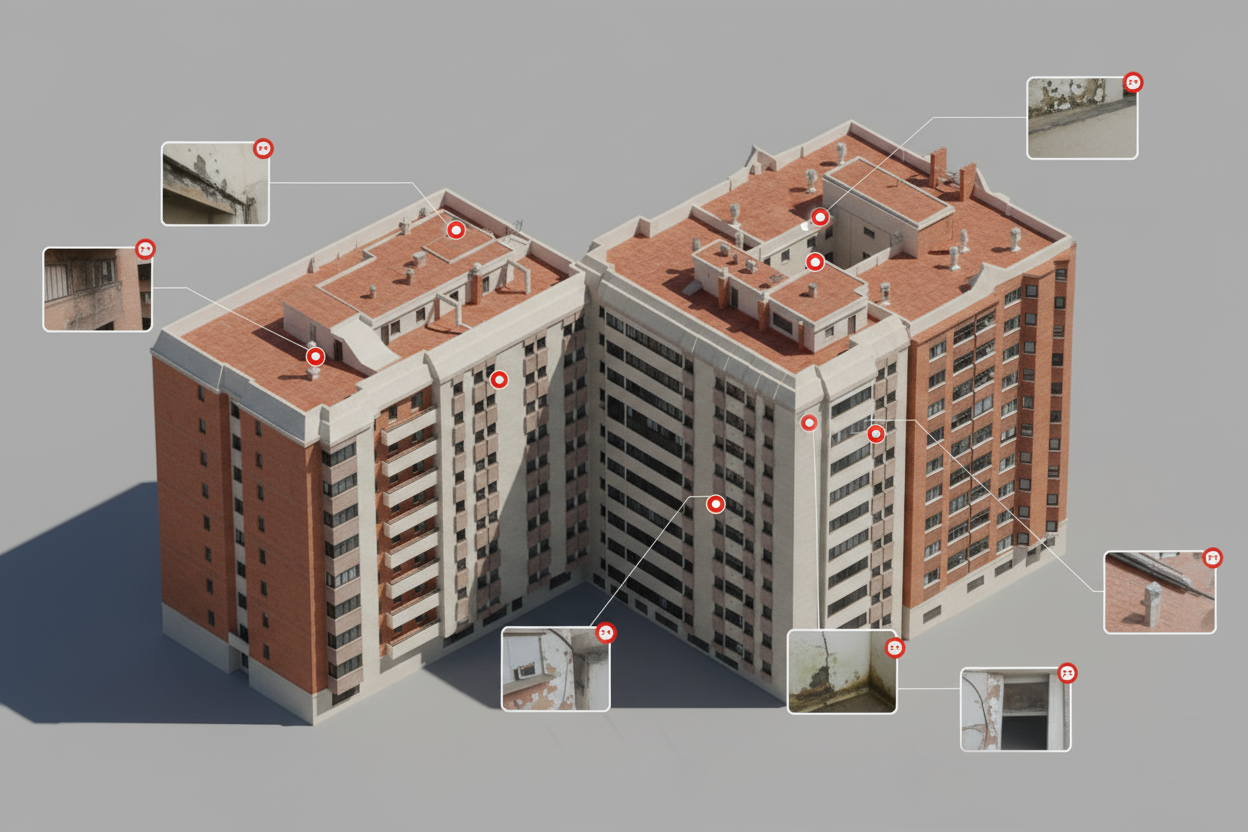
In material captured within the agreed coverage, the model can flag indications of cracks, damp or other defects for professional review.
We analyse parts captured within the agreed coverage and cadence. Metrics and thresholds define what is flagged; low confidence and capture errors are reviewed before a release decision.
We can estimate counts or paths across included cameras where coverage, permissions and privacy requirements allow; occlusions and lost tracks are recorded as exceptions.
We extract configured fields from compatible documents and apply validation before sending them to a system; incomplete or uncertain readings require review.
When included in scope, a report links available evidence, confidence and history within the agreed retention. Missing evidence or low confidence is flagged as an exception, not asserted as a confirmed result.
We connect compatible sources and systems in scope. Providers, formats, permissions, cadence, retries and owners for exceptions are documented before the pilot.
We define the cameras, photos, video or batches in scope and verify permissions, coverage, quality and ingestion events before processing.
We validate the model on a representative sample using agreed metrics. Only the sources and classes in scope are processed, and failures remain visible.
Results that meet thresholds are annotated with available evidence and confidence; uncertain cases or capture failures go to human review.
We deliver the configured format, such as PDF, Excel or a compatible API. Only defined events generate alerts; retries, failures and exceptions are logged and assigned.
We can assess phone photos, IP or drone video, CCTV and stored batches. Feasibility depends on resolution, framing, lighting, cadence, permissions and coverage; a representative sample defines the sources in scope and whether capture must be adapted.
Not necessarily. We test a sample from the available cameras or photos and check quality, coverage, permissions and integration. If it does not meet the agreed criteria, we document which source or capture setup must change before the pilot.
Reliability is validated on representative data using agreed metrics, thresholds and acceptance criteria; model confidence does not replace that validation. Low confidence, capture errors and other exceptions go to human review before entering a report or triggering a decision.
The proposal documents the processing and hosting provider and region, access roles, retention and deletion, and permitted training use. Exclusion from third-party training and EU-only residency apply only when supported by the agreed provider, plan, contract and configuration; GDPR compliance also depends on the architecture and the controller's obligations.
Results can be delivered as PDF, Excel or via API when the format and integration are compatible and in scope. Only configured events and thresholds trigger actions; retries, delivery failures and exceptions are logged and routed to the responsible role.
Tell us what you need to detect: we review a sample and the available sources, then confirm the response window based on business-day availability together with the requirements for a pilot.